Why Pope Leo’s Eliminating Latin
as the Definitive Language of the Church
...
will Result in
Irrecoverable Loss
for Catholicism
§1. The curial institutions
will normally draft their
acts
in Latin or in another language.”
*
The Roman
Catholic Church as a
Magisterial institution possessing the indefeasible
character of divine certainty, has:
in Latin.
One-Thousand-Six-Hundred-Years-and-Ten-Months
...
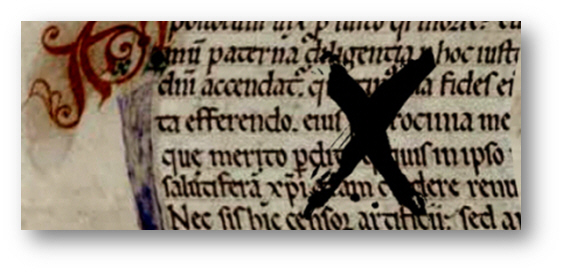
Latin is the language through which the
Roman Catholic Church has uniquely and definitively expressed
itself for at least the 1,600-years-and-10 months prior to Pope
Leo XIV’s shocking and sweeping mandate on November 24, 2025
that pronouncements of the Church’s curial offices are no longer
to be exclusively rendered in Latin, but “in Latin or
in another language.”
Despite any
rhetoric to the contrary, this is a monumental shift
in paradigm. Until Pope Leo XIV, every “Curial act,” until
last month, had been “drafted” by default in Latin —
as it had been for at least 1,600 years.
Are we to
really to believe, then, that this latitude in language
— the rendering of official documents in (multiple)
vernacular languages — implicitly by the Curia alone,
although this is carefully not stated — is not a segue
into the wholesale repudiation of Latin as constituting a
distinctly Catholic impediment to an evolving
pan-Ecumenism (and most especially in Europe, to Protestantism)?
Truly, are we
to believe the Church no longer possesses the intellectual,
scholarly, and linguistic assets that had made her the envy
of the civilized world for 2000 years? Her scholars, her Bollandists,
her Latinists are no longer capable of translating into the
vernacular of every nation to which she has brought the light
of Faith for millennia past … what their predecessors had up
to November 25, 2025?
Of course
this is a rhetorical question!
What, then,
is the impetus to this change that will inevitably, indeed,
undoubtedly, not merely impede, but necessarily destroy
the very possibility of virtually any univocal
utterance, written or spoken, in the Church.
Pope Leo’s move will
forever frustrate any attempt to arrive at universally
accepted and indisputable meaning, any precise denotation
of words or phrases that allow for no equivocation —
and to which all divergent or competing translations can appeal
as to an absolute arbiter in any dispute.
For this alone
is the vocabulary necessary for and indispensable to doctrine
and dogma.
A Dramatic Shift in Paradigm
I will argue that there are not simply compelling, but indisputable
reasons that the Roman Catholic Church, prior to Pope Leo, used Latin
not as just a theological, but a precise juridical, pedagogical,
archival, and institutional language.
Why, in a dramatic shift of paradigm, Pope Leo has apparently chosen
otherwise, we can only speculate upon — which I will not do.
However, if we choose the least contentious (but misleading)
explanation we will probably arrive at something like the following:
Drafts only?
If we argue that by its explicit wording this paragraph pertains
to “drafts” only, that is to say, to preliminary
versions, tentative in nature only, and understood as
being presented in a provisional form waiting
to be rendered into the logical and historical framework of
the 1,600-year Latin in which, and through which,
the Church has always articulated itself, its dogmas, and its
doctrines, then all is well.
It nevertheless remains that even in their most articulate vernacular
form, these several (many?) languages can only, and at best,
approximate any Latin version —and will, at worst, deviate
from it. Either Latin cannot be reconciled with these
vernaculars, or these vernaculars cannot be reconciled with
Latin.
This leaves the Roman Revisionists with an uncomfortable choice:
one language group must be left out in the cold. They cannot
choose to leave out Latin without undermining the very historical
framework and foundation upon which the Church exists. But given
the Leonine mandate how, then, shall they proceed?
What is more, without a single language invested with what attains
to apodictic certainty through nearly two millennia of historical
authority through unbroken doctrinal, juridical, and theological
form — in Latin — a single authoritative linguistic source,
to which every “other language” must appeal or submit to in
the way of final and decisive denotation, providing both
recourse and redress to competing vernaculars.
A plurality of languages clearly cannot achieve this.
On the other hand
…
If this indeed is the case, why bother to add the disjunctive
“or” (“or in another language.”)
in the first place? What is the purpose of introducing
this qualification at all?
That is to say, if the directive that, “The curial institutions
will normally draft their acts in Latin or in another language”
does not constitute a clear divergence from the unique historical
language of the Church, why is it directed to do so
in “another” language, not simply as permissive,
but in so stating, implicitly endowing “another” (any
language) with the same historically stable and unique characteristics
that are inherent within, and inextricable from Latin? Especially
in the way of precision and immutability (I will explain a bit
further on)?
Notice, too, that the word “will” is used as an imperative
— not “can,” nor “are allowed to,” but is applied with equal
force to both the vernacular and the Latin
— but how can this possibly be?
A literal Latin composition will always differ
from every vernacular rendering. What is more, each and every
translation distinct from the Latin will differ not just from
any “optional,” “alternate,” or even “concurrent” Latin rendering
— but from each other as well. In other words,
every vernacular translation will be applied without
prejudice to each other. All will be “correct” despite
any nuance within, or latent conflict between, them.
To further complicate matters, given many translators (and assuming
that each translator possesses a mastery of the subtleties inherent
in their own language) and subsequent revisions by still
other translators within that language, the combined
likelihood of a divergence in translation between languages
is not just “possible”— but inescapable.
What does this mean for the Church?
In abrogating the only non-evolving language —
Ecclesiastical Latin — the language through which alone the
stringent conceptual architecture of the Church has been
articulated, sustained, and preserved, defining its dogma, and
sixteen millennia of doctrine — the Magisterium of the
Church will be divided between the Church of roughly 1600 years
prior to Pope Leo XIV, and the post-Leonine Magisterium articulated,
not through one, but through many languages in
many translations. In a word, should this prove to be
the case, it is a move away from apodictic Magisterial
certainty.
If
this is what Pope Leo XIV intends, it is not just momentous, but
potentially catastrophic, and this is why: the distinct linguistic
morphology of Latin is not shared by any other language
— it possesses an unparalleled and historically embedded matrix
of denotation and meaning — not only which has been
— but in which it has been —
consistently propagated through sixteen centuries in a way
indispensable to matters doctrinal and juridical within Holy
Mother Church.
Any appeal to certainty — a certainty absolutely vital
to doctrine and unimpeachable Magisterium — that falls
short of an unequivocal standard to which all
translations must appeal for univocal substantiation — and
which alone can exclude all possible translational doubt
— of itself subverts the very certainty that it seeks, or
must abolish apodictic certainty itself — and with it, Holy
Mother Church.
Why?
The Roman Catholic Church is the only institution in
the world that (for 2000 years) has claimed absolute certainty
concerning its dogmatic and doctrinal utterances. No other
religion has made, or been able to make this claim, and possessed
the credentials for doing so, and certainly no social or political
institution in history has made a pretense to indefeasible
ideological claims. Polities and societies change, and
such changes are integral to the institutions which articulated
them. But this is not so for the Church — nor can it
be. The very notion of something to be logically understood
as dogma and doctrine, and at the same time
being questionable and uncertain, is simply an abuse of language.
Dogma is certainty. Doctrine is certainty.
If,
henceforth, the teachings of Holy Mother Church no longer —
because they can no longer — be understood as unequivocal
and categorically certain, then the Church forfeits her right
to teach anything absolute, and with that forfeiture,
the historical certainty of her Magisterium as of Pope Leo’s
devastating change on November
24, 2025.
This, of course, will not play out instantly; no more than the
devastating changes following the implementation of Vatican
II played out immediately — but it is now following a trajectory
well established since 1963 and brought to ruinous fruition
in the decades that soon followed.
How tragic that the pathological mentality of the 60s so aggressively
leached into the Catholic Church, and persists in it
with a virulence seen nowhere else.
Perhaps it is due, in part, to the cardinals and
bishops who, almost without exception, were and are
of that generation, or the children of
that generation, both of whom were indoctrinated in the
“counterculture”
of the 60s: rebellion against authority and established
form (behavioral, moral, artistic, literary, etc.), revolution,
experimentation, unrestrained freedom of expression (much as
we had found in the countless iterations of the Novus
Ordo Mass) resistance, the inauguration of Earth Day
(and environmentalism) in 1970 (and consecrated in the Church
by Pope Francis in
Laudate si and
Laudate Deum).
There is, however, another part: something primeval,
something insidiously deep and dark that I cannot shake, an
ontological menace I cannot ignore.
“Something”
— the name of which I will not dignify to utter — now crouches
in the corner and lurks among the shadows of men, and I believe
that it is profoundly involved in the unfolding of the uncertainty
to follow.
A
Three-Fold Forfeiture
We must, in the meanwhile, be
absolutely clear about this, and why Pope Leo’s
eliminating Latin as the lingua franca of Holy Mother
Church is a plunge, henceforth, from indefectible
certainty into inescapable skepticism concerning
all things ecclesiastical, doctrinal, and
juridical — and why it will be the undoing of the now
Post-Catholic Conciliar Church of Vatican II.
Latin
is
often, and mistakenly, referred to as a “Dead Language”
inasmuch as it is no longer the spoken language belonging to
any existing country or people. This, however, is
misleading. Yes, Latin
is indeed — and quite fortunately — dead to nations, but
nevertheless remains alive to and within the
Catholic Church.
This has
far-reaching consequences: for we can now see that Latin
became, and remains, the conceptual property of the
institution, the Church; that is to say, it is the
language in which and through which it
articulated the very concepts by which she herself is
defined and understood. It is not the possession of a
culture. It transcends nations, peoples,
cultures, borders, precisely because it is a property of
none and a settled medium of all.
Latin is the
linguistic architecture of a divine institution
approximating as much as possible in the immutability of
her language, the immutable ordinances entrusted her by God.
This language alone makes dogma, doctrine, and law immune to
ambiguity and error. The denotation (the irreducible, the
strictly literal meaning of a word) in Latin establishes
boundaries beyond which interpretation may not pass. Once a
term is authoritatively defined by the Church its meaning is
set, fixed, and unalterable, and for this reason it is
precisely the linguistic medium for matters juridical,
theological, and liturgical, especially in the way of
maintaining unity.
When. On the
other hand, the Church substitutes a necessarily evolving
vernacular (and not simply of any country, but of
all countries) for the non-evolving institutional
Latin — and at the same time presumes to maintain the
three-fold unity of dogma, doctrine, and law that
characterized the Church prior to November, 2025, it will be
an inescapably impossible. It nearly attains to a
mathematical certainty.
An Analogy
Consider a
very pertinent analogy: following Vatican II we witnessed
the emergence and standardization of the vernacular liturgy
(a change that was not called for by the
Council in the December 4, 1963 Conciliar document
Sacrosanctum Concilium §36.1 (“Linguae latinae usus,
salvo particulari iure, in Ritibus latinis servetur —
The use of the Latin language is to be preserved in the
Latin rites.”)
This change
from Latin to the vernacular resulted in what essentially
became a proprietary liturgical language for each
nation, and as a consequence no two linguistic groups could
coherently participate in each other’s liturgies
apart from signs and gestures (the most primitive forms of
communication), and theology, no longer universally
anchored in Latin, became regional, acquiring social
and political characteristics unique to different countries
and continents (e.g. “Liberation Theology” in South America,
“Synodalism” in Germany).
And this, I
suggest, is a mere harbinger of things to come, for in going
forward it will open the Church to inevitable controversies
and disputes that will not be amenable to any linguistic
arbitration. Among languages with competing denotations in
ecclesiastical issues, which language will prevail … and why
should it?
This is the
uneasy state of a church in flux … so much so that it is
difficult to see how, henceforth, she will be able to speak
to her children unequivocally and in reassuring certainty as
she had in ages past.
A Cautionary
Note
However
fraught with the seemingly insurmountable problems that we
have addressed — and yes, the dangers from which I cannot
see Holy Mother Church now able to extricate herself — we
now come to an impasse. Reasoning and logic can go no
further; at least to my own modest extent they have been
depleted. What recourse do we have then?
The only
conclusion that I foresee and one to which all Catholics are
obligated to concede is this:
The Church
is Christ’s. It is indefectible. To utter this within a
whirlwind of confusion is an Actus Fidei, an act of
Faith. Christ is greater than any confusion sown in the
Church. As one poet put it, “He knows what He is about.”
Pope Leo Has
the Authority to Make This Change
However
perplexing, imprudent, and ill-conceived we may find Pope
Leo’s decision to be, as Catholics we are bound to
acknowledge that, as pope, Leo possesses supreme, full,
immediate, and universal authority in the Church in
matters of Discipline (law and governance),
Liturgy (rites, rubrics, and approved languages) and the
Adminstration of ecclesial life. He can enact
universal laws, suppress or permit rites, regulate
liturgical language, and require obedience while a law
stands. This authority
is invested in the Petrine Office itself.
In a word,
Pope Leo has the authority to make this change, and
however opaque to our understanding, however inconsistent
with reason and precipitously detached from two millennia of
ecclesiastical history, it has been done — and only a future
pope can rectify it.
In hoc et in omnibus, sicut Deus vult
_________________________
* “General Regulations of the Roman Curia, 24.11.2025
Title XIII
LANGUAGES IN USE
Art. 50
§1. The curial institutions [*] will normally draft their
acts in Latin or in another language.”
https://press.vatican.va/content/salastampa/it/bollettino/pubblico/2025/11/24/0896/01618.html
Geoffrey K. Mondello
Editor
Boston Catholic Journal
January 11, 2026
Feast of
St. Hyginus,
Pope
and
martyr
Totally Faithful to
the Sacred Deposit of Faith entrusted
to the Holy See in Rome
“Scio
opera tua ... quia modicum habes virtutem, et servasti
verbum Meum, nec non negasti Nomen Meum”
“I
know your works ... that you have but little power,
and yet you have kept My word, and have not denied
My Name.”
(Apocalypse 3.8)
Copyright © 2004
- 2026 Boston Catholic Journal. All rights reserved.
Unless otherwise stated, permission is granted by
the Boston Catholic Journal for the copying and
distribution of the articles and audio files under
the following conditions: No additions, deletions,
or changes are to be made to the text or audio files
in any way, and the copies may not be sold for a
profit. In the reproduction, in any format of any
image, graphic, text, or audio file, attribution
must be given to the Boston Catholic Journal.
|
|









 Printable PDF Version