

|
Editor�s
note:
There are
5,430 Catholic bishops in the world as of this writing on February
15, 2026.
A Line in
the Sand
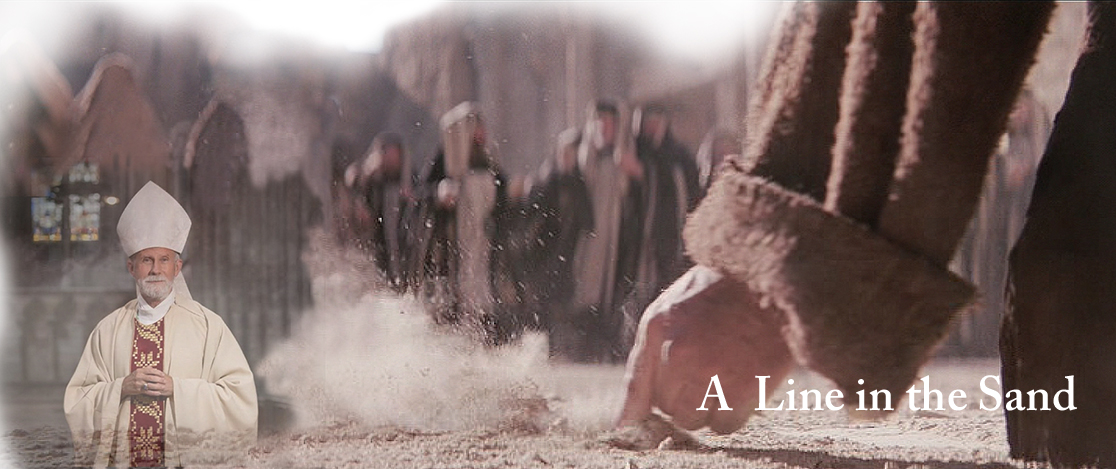
[Bishop Strickland]: �Every Texan knows this story: Long before we knew about politics, before we knew the arguments, before we knew how to quibble over details, we were taught something in school that shaped our bones. At the Alamo, there came a moment when there were no more letters to send, no reinforcements coming, no negotiations left to try. The enemy was at the gates. Surrender had been demanded. And everyone knew what surrender would mean. So the commander � William Barrett Travis � gathered his men � not to inspire them, not to give a pep talk, but to tell them the truth. He drew a line in the dirt. On one side of that line was safety � at least for the moment. On the other side was almost certain death. And he said, in effect: �Choose.� Only one man stepped back. The rest stepped forward. That line in the sand was not drawn to start a rebellion. It was drawn to end illusions. Crossing it did not guarantee victory � it guaranteed fidelity. And whether we like it or not, that is where the Church stands right now. The Church is in an emergency. Not an emergency invented by commentators, not a mood manufactured by social media, not hysteria. A real emergency � measured not in feelings, but in facts. An emergency measured by silence where there must be answers. In tolerance where there must be correction. In shepherds who refuse to name wolves, while those who simply want to guard the flock are treated as a problem. Let me be very clear: this is not about personalities. It is not about preferences. It is not about clinging to the past. It is about survival � not of an institution, but of the priesthood, the sacraments, and the Catholic Faith as it has been received, handed down, and guarded for centuries. When men who openly contradict Catholic teaching are tolerated, promoted, even celebrated � while those who hold fast to tradition are restricted, sidelined, or ignored � something is upside down.
When confusion is
indulged and fidelity must beg to survive, authority has stopped
doing what authority exists to do. And there comes a point when silence itself becomes an answer When a crisis is acknowledged, when a plea is made soberly and respectfully, and when that plea is met with silence, delay becomes a decision. Inaction becomes a judgment. Refusal to act becomes abdication. This is not theory. This is history. The Church has faced moments like this before � moments when men were forced to act not because they wanted confrontation, but because the alternative was surrendering what had been entrusted to them. That is why the name Archbishop Marcel Lefebvre still provokes such strong reactions. Not because the moment was comfortable, but because it was clarifying. No one claims those decisions were light. No one claims they were painless. But they were made under the conviction that necessity had arrived, that waiting longer would mean watching something essential die. And today, we are standing in another moment of necessity. This is not about one group. It is not about one society. It is not about one bishop, or one letter, or one unanswered request. It is about a pattern � a pattern where orthodoxy is treated as dangerous, tradition is treated as suspect, and fidelity is portrayed as rigidity while error is praised as pastoral sensitivity. It is about a moment when the things the Church once defended without apology must now justify their existence. When the preservation of the priesthood is treated as optional. When the formation of priests is obstructed. When the ordinary means of apostolic continuity are quietly denied. And at that point, the line is already being drawn. Not by agitators. Not by rebels. But by reality itself. At the Alamo, one man stepped back. His name was Moses Rose. History does not mock him. It simply records the choice. That is what lines do. They do not condemn. They reveal. The line does not create courage or cowardice. It exposes it.
And the line the
Church faces today is not asking who is angry, who is loud, or who
is popular. It is asking who is willing to remain faithful when
fidelity costs something. Because there are things worse than
defeat. There are things worse than being crushed. There are things
worse than dying. There is surrender
Our Lord did not
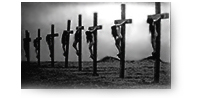
draw His line in sand. He drew it in blood. He stood silent before
Pilate not because truth was unclear, but because truth does not
negotiate with lies. He did not promise safety. He did not promise
comfort. He did not promise success. He promised the Cross And He warned his disciples plainly what fidelity would cost them. So when we speak today about lines being drawn, we are not inventing something new. We are standing where Christians have always stood, when obedience to God and submission to confusion finally diverge.
Today, I am asking
who is honest. I am not asking who feels secure. I am asking who is
faithful. Because the line is already there
It has been drawn by
silence. It has been drawn by inversion. It has been drawn by the
refusal to act when action is required. And the only question left �
the only honest question � is whether we are willing to cross it.
Not with triumphalism. Not with rebellion. But with fidelity. The Church survives by saints And saints have always known what to do when the line appears. And now I am going to say some things plainly, because the hour for careful phrasing has passed. There are people who will say that naming realities like this is divisive. They are wrong. What is divisive is tolerating error while punishing fidelity. What is divisive is demanding silence from those who believe what the Church has always taught, while applauding those who contradict her openly. What is divisive is calling confusion �pastoral,� and clarity �dangerous.� And we have seen this pattern long enough now that pretending otherwise is no longer honest. There are priests and bishops who publicly undermine Catholic teaching on marriage, on sexuality, on the uniqueness of Christ, on the necessity of repentance � and nothing happens. They are praised for their �accompaniment.� And we are told this is mercy. But when priests want to offer the Mass as it was offered for centuries, when they want to be formed according to the mind of the Church that produced saints, when they want bishops so the priesthood itself does not die out � they are treated as a problem to be managed. That is not mercy. That is inversion. And when this inversion is brought directly to Rome � calmly, respectfully, without threats � and the response is silence, we are no longer dealing with misunderstanding. We are dealing with refusal. I am speaking here of the Society of St. Pius X. They are not asking for novelty. They are not asking for power. They are asking for bishops � because without bishops there are no priests, and without priests there are no sacraments, and without sacraments the Church does not survive in any meaningful way. They asked. They waited. They received no answer that addressed the reality. And I will say this plainly: when heresy is tolerated but tradition is strangled, something has gone terribly wrong. When those who break with doctrine are welcomed, and those who cling to doctrine are treated as suspect, authority has turned against its own purpose. That is not rebellion speaking. That is fact. Some will say, �But you must wait.� Some will say, �But you must trust.� Some will say, �But you must be patient.� Patience is a virtue. But patience does not mean watching the priesthood die while those responsible refuse to act. Trust is necessary. But trust does not mean pretending silence is wisdom when it is not. Obedience is holy. But obedience has never meant cooperating in the erosion of the Faith.
There is a moment
when continuing to wait becomes a form of surrender. That moment has arrived
And I know some
people will recoil when they hear that. They will say this language
is too strong. They will say it unsettles people. Good Because a Church that is never unsettled by truth is already asleep. Our Lord unsettled people constantly. He overturned tables. He named hypocrisy. He warned shepherds who fed themselves instead of the flock. He did not speak gently to those who distorted the truth while claiming authority.
And I am not
interested in a peace that is purchased by silence. I am not
interested in unity that requires lying to ourselves. I am not
interested in stability that comes at the price of surrender. The line has been drawn It is being drawn every time a faithful priest is punished for doing what saints did. It is being drawn every time error is tolerated because correcting it would be uncomfortable. It is being drawn every time Rome chooses silence when clarity is required. And here is the part that must be said out loud: lines like this are never drawn by those who want conflict. They are drawn by reality when authority refuses to act. At the Alamo, the men who crossed the line did not think they would win. They knew they would likely lose. They crossed because surrender would have meant denying who they were and what they had been entrusted to defend. That is the choice facing the Church now. Not between victory and defeat. But between fidelity and surrender. Between truth and managed decline. Between saints and administrators. I am not calling for rebellion. I am calling for honesty. I am not calling for chaos. I am calling for courage. I am not calling anyone to abandon the Church. I am calling the Church to remember herself. Because if we will not defend the priesthood, if we will not defend the sacraments, if we will not defend the Faith when it costs something � then we are already stepping back from the line. And history will record that choice too. The Church does not need more silence. She does not need more delay. She does not need more careful statements that say nothing. She needs men who will stand, speak, and if necessary, suffer � without illusions.
Because the line is
no longer theoretical. It is here And each of us � bishop, priest, layman � is already deciding where we stand. And now I am going to stop explaining. Because there comes a moment when explanation becomes avoidance, and words become a way of delaying obedience.
The line is no
longer in history books. It is no longer theoretical. It is no
longer something we debate at conferences or behind closed doors. It is here And it is not asking what position you hold, or how many followers you have, or how carefully you word your statements. It is asking one thing only: whether you will stand with the truth when standing costs you something. Because this is what must finally be said without ornament or apology: a Church that will not defend her priesthood will not survive. A Church that treats fidelity as dangerous and error as pastoral has already begun to surrender. A Church that answers emergencies with silence is choosing decay over courage. That is not an insult. That is not a threat. That is a diagnosis. And diagnoses are meant to wake people up and call people to action. There is no neutral ground here. There is no safe middle space where one can quietly wait and hope someone else acts. Silence itself has become a position. Delay itself has become a decision. The line is drawn every time truth is asked to wait. Every time error is excused. Every time courage is punished. Every time a shepherd looks away.
And the most
terrifying thing about moments like this is not that some will
choose wrongly. It is that many will choose quietly � and tell
themselves they chose nothing at all.
History will not
agree with them Because our Lord does not ask whether we were comfortable. He asks whether we were faithful. He does not ask whether we preserved our standing. He asks whether we carried our cross. He does not ask whether we survived. He asks whether we loved the truth more than our own safety. So I will end this where I must.
Not with a strategy.
Not with a program. Not with another conversation. But with a call to kneel If you are listening to this and your heart is unsettled, do not numb it. If you are angry, examine why. If you are afraid, admit it. And then pray � not for the Church to become easier, but for her to become holy again.
Pray for bishops who
will speak even when it costs them everything. Pray for priests who
will remain faithful even when abandoned. Pray for Rome � not that
it will manage this crisis, but that it will answer it. And pray for yourself Because the line is already there.
And when the noise
stops, and the chairs have finished hitting the floor, and there is
nothing left to hide behind, each of us will have to answer the only
question that matters: Where were you standing? May Almighty God bless you and keep you, in the name of the Father, and of the Son, and of the Holy Ghost. Amen.�
Bishop Joseph E. Strickland
February 2026
Geoffrey K. Mondello Comments? Write us: editor@boston-catholic-journal.com
|